
Online gaming is massive, something I've touched on previously in my blog, and nowhere more so than Microsoft's Xbox LIVE, but for those of you who are yet to be bitten by the bug, yet to see your Xbox 360 reach it's full potential, I bet you're sitting there thinking: “Paying a fiver a month to play online? Why should I?”
The answer, is quality. The Xbox LIVE community thrives because of the people who make it what it is. Only last month we heard the story of players continuing to play Halo 2 after Microsoft decided to shut original Xbox LIVE down. Nowhere else would you get the same sort of devotion, except perhaps the most dedicated hardcore Counter-Strike servers.
So to initiate the unconverted, I've decided to pick out the top five games which show the best of what Xbox LIVE has to offer. While there might not be many surprises on the list, and there are many many more excellent games to be enjoyed online, these five together give the most enriching and entertaining all-round online experience.
1) Halo 3 (Developer: Bungie // Publisher: Microsoft)
 So first up we have the big daddy of modern online gaming, the game that took the idea to a whole new level. By March last year over a billion matches had been played on multiplayer and it still ranks highly on the weekly Xbox LIVE play figures, reaching number three on week May 24th according to Major Nelson.
But just because a game is popular, doesn't mean it's automatically good, we all know what sheep people can be. In Halo's case though, the Bungie team have learnt from the multiplayer in Halo 2 and improved everything about the matchmaking and game types to provide as wide a range of game types and general destruction as possible.
Standard deathmatches are all well and good, but fancy driving around the map with explosions everywhere from infinite ammo rocket launchers? Well you can thanks to the 'Rocket Race' gametype – although it is rare to come across these days – as well as the more traditional 'King of the Hill', 'Gladiator' and 'Team Swords' all being hugely enjoyable modes.
Another feature which in many ways was underused is the infinitely customisable 'Forge' mode, in which players can customise any of the maps in the game with additional crates, explosives, weapons, vehicles, practically anything in fact, leading to some inspired custom levels. The latest DLC pack 'Mythic' – released with Halo ODST – included a map called 'Sandbox' with large areas above and below the actual map for exactly this reason, sadly Bungie made little effort to introduce the best custom levels to the rest of the community and so the level failed to fulfil its potential.
Despite that Halo continues to be consistently fun to play despite being released in 2007, and the generally team-based play means the learning curve isn't too steep.
2) Battlefield: Bad Company 2 (Developer: DICE // Publisher: EA)
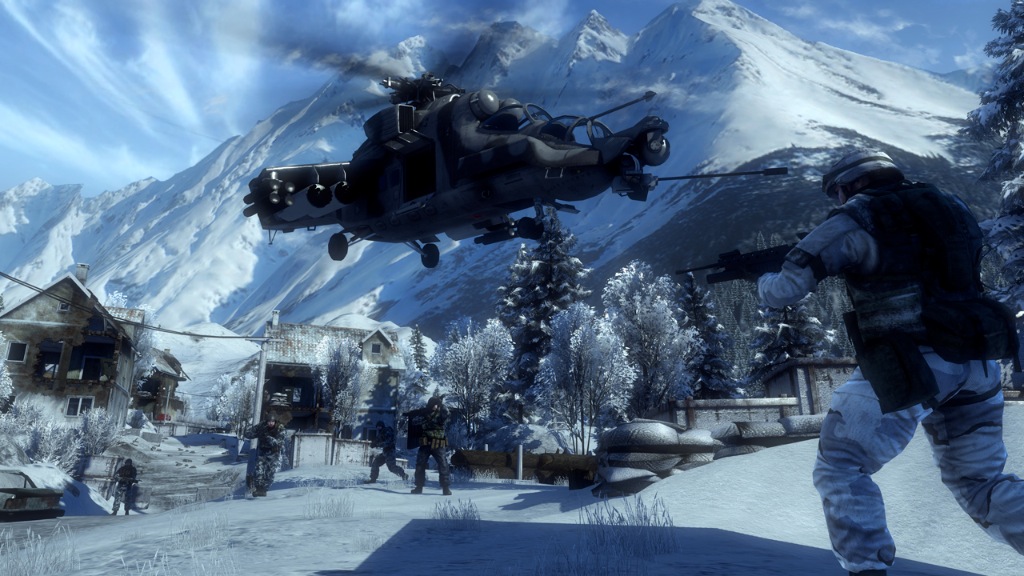
While many of you at this moment are no doubt incensed with anger at me choosing this game in place of the astronomically successful Call of Duty: Modern Warfare series.
The reasons this game tops it for me are two fold: firstly – Modern Warfare is hard. Now I've no problem with things being challenging, but Call of Duty is not a game you can just pick up and enjoy, you have to unlock the higher ranks for decent weapons and perks and though the Death Streak perks on MW2 initially give you a tiny edge, it's easily the most frustrating game I've ever played for the sheer “Here we go, oh no I'm instantly dead”-factor.
On Battlefield though, team play takes a new meaning as you can spawn on your team mates. Of course they still die just before you get a chance to appear, but you find you can get out of a fix pretty quickly if you just hide in the foliage for ten seconds.
The multiplayer is based around a class system, namely Assault, Engineer, Media and Recon, and are as self-explanatory as they seem. There is some range, but not enough to make any one class miles better than any other, and a good balance in multiplayer is key.
The maps on the game are nicely varied, and the destructible environments give a certain uneasiness, since a place of safely can be deleted in an instant by a stray tank shell.
The vehicles themselves are what make the multiplayer so enjoyable. You and friends commanding the skies from a HIND helicopter or creating a Tank convoy to storm the enemy position. Not that vehicles make you invincible either, meaning a solid defence can take them down.
The lack of multiplayer modes, which are set to be increased come the next DLC instalment, don't make the game repetitive or dull at all, and you really get a sense of a prolonged skirmish even in short games because of the amount of time in the action, though if you get the timing wrong when spawning you can find yourself with a long walk to the objective.

If you prefer the dead to the living, then zombie dismember-em-up Left 4 Dead 2 is right up your street. Not only is it the most varied zombie game I've ever come across (though Dead Rising 2 is shaping up very nicely) it gives you the chance to be a zombie, and not just a trudging brain-muncher either.
The 'special' infected (the game's term for zombies) have fantastic powers, from releasing your tongue as a lasso to ensnare your victims, covering them in toxic gunge or pouncing on them from a nearby rooftop to claw up their face.
It may all sound a bit brutal, but this is a battle for survival after all, and this game like no other makes you value your life as you manically swing a cricket bat, or gnome, to defend yourself from hoards of evil nasties.
The bedrock which the first game set down has been well build upon this time around, with 'Survival' and 'Scavenge' modes adding some variety to the usual run-of-the-mill campaigns, which themselves are very varied and enjoyable in their own right. 'Realism' adds a challenge for veterans of the first game, taking away helpful pointers such as weapon highlighting and friends' outlines when out of view, making things instantly more treacherous.
Xbox LIVE is woven into the structure of this game, it would be a shadow of itself without the help of random online strangers, however tool-ish they can sometimes be.
Learning how and when to use the special infected, particularly in the short sharp bursts that 'Scavenge' offers, is even more enjoyable than tearing through the infected with your AK-47 as one of the very vulnerable survivors.
As much as it's fun to work with your friends, it's even more fun to hunt them down and devour them, with the sadistic pleasure we all feel seeing our friends in some mild peril – albeit in video game form.
This game also gets the 'Pick Up and Play' award for simplicity as Valve, with their considerable experience in first person shooters (stand up and take a well-deserved bow Half Life), have created the most intuitive control system, keeping things simple to make the learning curve as shallow as possible, and it pays off - gruesomely.
4) Red Faction: Guerilla (Developer: Violation Inc // Publisher: THQ)

Computer games give you the ability to enact your greatest and wildest fantasies from the comfort of your own sofa, and who in their right mind hasn't liked the idea of blowing up everything in sight?
Thanks to Red Faction: Guerilla that dream came one giant jet pack flying leap closer, with Violation Inc's highly impressive 'Geo-Mod 2.0', a gameplay engine which dynamically maps the destruction of buildings, allowing you to cause the roof of a building to fall crushing the building beneath it and other such havoc with the game's various structure-deleting equipment.
In multiplayer this engine takes a more significant role in gameplay as towers fall to become bridges and the building you're safely hiding inside quickly crumbles around you, forcing an energetic and varied style of play.
Game modes here are more inventive than most games too, but all containing a fair amount of destruction for good measure, naturally. The highlight is the 'Destroyer' game mood, which is pretty much as it sounds, one player tries to destroy as many buildings as possible while the rest of the team protects them, and the other team does the same. There are bonus points on offer if you kill the enemy destroyer.
It tends to work better on some maps than others, since sometimes people are too efficient and blowing things up and there is nothing left on the map by the end of the game, but it makes for some interesting matches.
Another key thing to mention is that the standard weapon is a sledgehammer, adding a satisfying twist to the standard melee attack, not to mention some amusing unlocks as you reach higher levels (ostrich-hammer anyone?)
5) Splinter Cell: Conviction (Developer: Ubisoft Montreal // Publisher: Ubisoft)

As the lone wolf of stealth action, Sam Fisher is getting on a bit, but at the risk of ruining his 'one-man-army-super-badass' image, Ubisoft decided to bring in some now acquisitions for their highly-addictive cooperative mode 'Deniable Ops'.
Players control either 'Archer' (American, cocky, sarcastic) or 'Kestrel' (Russian, cold, calculating) in missions in secret complexes, installations and generally other covert things. What makes the game mode work is the free-roaming parts, which allow you to work with your partner to navigate a large area filled with enemies by working out a strategy.
Of course you just wing it a few times, but then get separated and killed pretty quickly so decide perhaps a tactic or two wouldn't be a bad thing. As much as it sounds like a lot of thought, after a while it becomes second nature, depending on how good your partner is, and you find progressing cooperatively even more rewarding than pumping your friends full of lead.
One place where the game really favours the coop mode over the standard campaign is the much touted 'Mark And Execute' system, which allows players to highlight a certain number of enemies depending on the weapon they are using them, and then press a single button to kill them all automatically in a matter of seconds.
Because the two games are connected together there is a bit of leeway between one player pressing the button and the other, meaning you can often watch your characters executing half a dozen enemies through various walls and other obstacles, suggesting their bullets have suddenly gained wall-felling powers.
What began as feeling like a bit of a tacked-on option in the run up to the game's release flourished considerably, thanks to – or even cause of - some significant delays, and made the title overall far better value for money.
So, if you're Xbox-ing away at home on Mass Effect 2 for hours on end, blissfully unaware of the outside world, try connecting your Xbox up to the magical wonderment that is the internet and watch your games instantly become even better.
James Michael Parry


 Posts
Posts

