Thursday, 10 June 2010

Music: Why iTunes is the the rotten core of Apple

iPods are everywhere. Over 260million have been sold worldwide, whether they are the cigarette lighter-like Shuffle (pictured), the tiny-screened Nano, the app-filled Touch or the tried and tested Classic.

Even the mobile phone market has been infiltrated, with iPhone, and later the 3G and 3GS versions, collectively selling over 51million units, but with approximately 4.6billion mobile phone subscriptions worldwide Apple still have some way to go to monopolise the market.

The one thing which connects all of these popular devices is the music organisation and player program iTunes, designed to bring the brand together and provide a one-stop-shop for all your music and televisual needs.

But despite Apple's popularity users are constantly faced with problems with the service such as computers crashing as soon as an iPod is plugged in, sluggish computer speed because of its high memory usage and refusing to burn CDs or freezing at any given moment, depending on the operating system you use.

Despite video iPods now being the norm, iTunes doesn't support video directly – you're forced to install Apple's Quicktime software, and you can't drag and drop songs from your computer to the player easily, instead you can only 'Sync' the iTunes library to your player – or do a 'Party Mix' in the case of a Shuffle.

Generally it seems like a company that made $42.91billion last year could do a better job, particularly when there are so many alternatives available, notably MusicIP Mixer, Songbird and MediaMonkey.

MediaMonkey in particular is good for MP3 player management, since it automatically tags songs from Amazon (with album art) effectively and carries that art and all the ID3 tag information to the player, even while playing something else.

Of course, MediaMonkey isn't exactly a household name – even a self-confessed geek like me has only barely come across it – which highlights Apple's greatest strength but also its greatest weakness. The company, in recent years in particular, has always focused on style over substance, products that look sleek and stylish but really do little to earn there hefty price tag compared to similar products from Creative or Sony.

One area where iTunes has had a real impact is music downloads, with the number of songs downloaded passing the 10 billion mark in February this year. Sadly the downloads themselves are in iTunes spacific .AAC file format, with a copyright protection system called FairPlay, meaning you can only play them on computers you've registered to your iTunes account or on your iPod.

If you wanted to be generous and give some music to a friend, you wouldn't be able to do it digitally and would be forced to burn it to CD, losing some of the audio's quality in the transfer – providing the music burns properly in the first place. While these measures were put in place to avoid unlawful sharing or transfer of songs, but with all the red tape and regulation you may want to dig out your old portable CD player and save yourself a whole lot of hassle.


James Michael Parry

Monday, 7 June 2010

Gaming: Top 5 Xbox LIVE Games

Online gaming is massive, something I've touched on previously in my blog, and nowhere more so than Microsoft's Xbox LIVE, but for those of you who are yet to be bitten by the bug, yet to see your Xbox 360 reach it's full potential, I bet you're sitting there thinking: “Paying a fiver a month to play online? Why should I?”

The answer, is quality. The Xbox LIVE community thrives because of the people who make it what it is. Only last month we heard the story of players continuing to play Halo 2 after Microsoft decided to shut original Xbox LIVE down. Nowhere else would you get the same sort of devotion, except perhaps the most dedicated hardcore Counter-Strike servers.

So to initiate the unconverted, I've decided to pick out the top five games which show the best of what Xbox LIVE has to offer. While there might not be many surprises on the list, and there are many many more excellent games to be enjoyed online, these five together give the most enriching and entertaining all-round online experience.


1) Halo 3 (Developer: Bungie // Publisher: Microsoft)

So first up we have the big daddy of modern online gaming, the game that took the idea to a whole new level. By March last year over a billion matches had been played on multiplayer and it still ranks highly on the weekly Xbox LIVE play figures, reaching number three on week May 24th according to Major Nelson.

But just because a game is popular, doesn't mean it's automatically good, we all know what sheep people can be. In Halo's case though, the Bungie team have learnt from the multiplayer in Halo 2 and improved everything about the matchmaking and game types to provide as wide a range of game types and general destruction as possible.

Standard deathmatches are all well and good, but fancy driving around the map with explosions everywhere from infinite ammo rocket launchers? Well you can thanks to the 'Rocket Race' gametype – although it is rare to come across these days – as well as the more traditional 'King of the Hill', 'Gladiator' and 'Team Swords' all being hugely enjoyable modes.

Another feature which in many ways was underused is the infinitely customisable 'Forge' mode, in which players can customise any of the maps in the game with additional crates, explosives, weapons, vehicles, practically anything in fact, leading to some inspired custom levels. The latest DLC pack 'Mythic' – released with Halo ODST – included a map called 'Sandbox' with large areas above and below the actual map for exactly this reason, sadly Bungie made little effort to introduce the best custom levels to the rest of the community and so the level failed to fulfil its potential.

Despite that Halo continues to be consistently fun to play despite being released in 2007, and the generally team-based play means the learning curve isn't too steep.


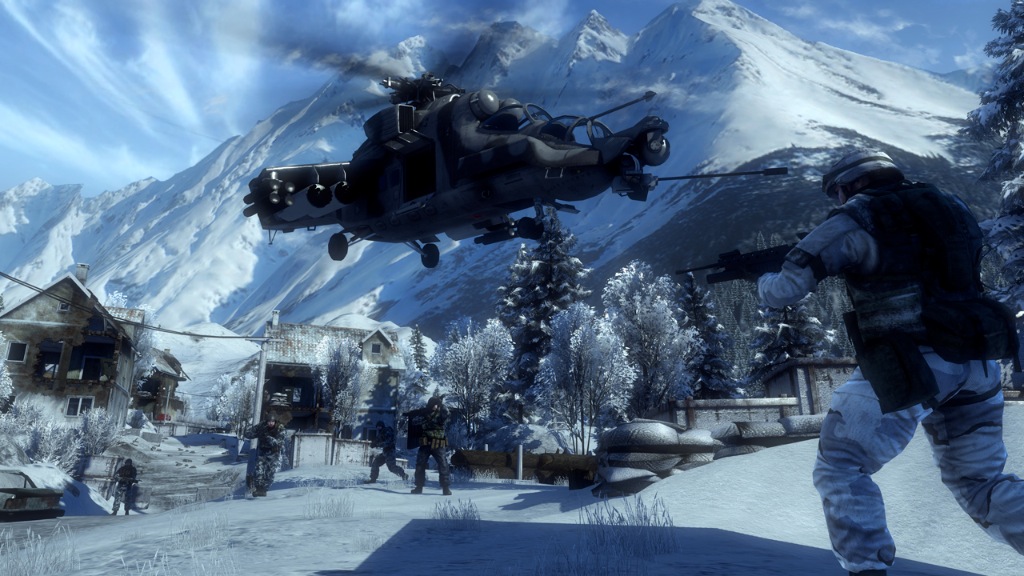
2) Battlefield: Bad Company 2 (Developer: DICE // Publisher: EA)

While many of you at this moment are no doubt incensed with anger at me choosing this game in place of the astronomically successful Call of Duty: Modern Warfare series.

The reasons this game tops it for me are two fold: firstly – Modern Warfare is hard. Now I've no problem with things being challenging, but Call of Duty is not a game you can just pick up and enjoy, you have to unlock the higher ranks for decent weapons and perks and though the Death Streak perks on MW2 initially give you a tiny edge, it's easily the most frustrating game I've ever played for the sheer “Here we go, oh no I'm instantly dead”-factor.

On Battlefield though, team play takes a new meaning as you can spawn on your team mates. Of course they still die just before you get a chance to appear, but you find you can get out of a fix pretty quickly if you just hide in the foliage for ten seconds.

The multiplayer is based around a class system, namely Assault, Engineer, Media and Recon, and are as self-explanatory as they seem. There is some range, but not enough to make any one class miles better than any other, and a good balance in multiplayer is key.

The maps on the game are nicely varied, and the destructible environments give a certain uneasiness, since a place of safely can be deleted in an instant by a stray tank shell.

The vehicles themselves are what make the multiplayer so enjoyable. You and friends commanding the skies from a HIND helicopter or creating a Tank convoy to storm the enemy position. Not that vehicles make you invincible either, meaning a solid defence can take them down.

The lack of multiplayer modes, which are set to be increased come the next DLC instalment, don't make the game repetitive or dull at all, and you really get a sense of a prolonged skirmish even in short games because of the amount of time in the action, though if you get the timing wrong when spawning you can find yourself with a long walk to the objective.


3) Left 4 Dead 2 (Developer: Valve // Publisher: Valve)
If you prefer the dead to the living, then zombie dismember-em-up Left 4 Dead 2 is right up your street. Not only is it the most varied zombie game I've ever come across (though Dead Rising 2 is shaping up very nicely) it gives you the chance to be a zombie, and not just a trudging brain-muncher either.

The 'special' infected (the game's term for zombies) have fantastic powers, from releasing your tongue as a lasso to ensnare your victims, covering them in toxic gunge or pouncing on them from a nearby rooftop to claw up their face.

It may all sound a bit brutal, but this is a battle for survival after all, and this game like no other makes you value your life as you manically swing a cricket bat, or gnome, to defend yourself from hoards of evil nasties.

The bedrock which the first game set down has been well build upon this time around, with 'Survival' and 'Scavenge' modes adding some variety to the usual run-of-the-mill campaigns, which themselves are very varied and enjoyable in their own right. 'Realism' adds a challenge for veterans of the first game, taking away helpful pointers such as weapon highlighting and friends' outlines when out of view, making things instantly more treacherous.

Xbox LIVE is woven into the structure of this game, it would be a shadow of itself without the help of random online strangers, however tool-ish they can sometimes be.

Learning how and when to use the special infected, particularly in the short sharp bursts that 'Scavenge' offers, is even more enjoyable than tearing through the infected with your AK-47 as one of the very vulnerable survivors.

As much as it's fun to work with your friends, it's even more fun to hunt them down and devour them, with the sadistic pleasure we all feel seeing our friends in some mild peril – albeit in video game form.

This game also gets the 'Pick Up and Play' award for simplicity as Valve, with their considerable experience in first person shooters (stand up and take a well-deserved bow Half Life), have created the most intuitive control system, keeping things simple to make the learning curve as shallow as possible, and it pays off - gruesomely.


4) Red Faction: Guerilla (Developer: Violation Inc // Publisher: THQ)

Computer games give you the ability to enact your greatest and wildest fantasies from the comfort of your own sofa, and who in their right mind hasn't liked the idea of blowing up everything in sight?

Thanks to Red Faction: Guerilla that dream came one giant jet pack flying leap closer, with Violation Inc's highly impressive 'Geo-Mod 2.0', a gameplay engine which dynamically maps the destruction of buildings, allowing you to cause the roof of a building to fall crushing the building beneath it and other such havoc with the game's various structure-deleting equipment.

In multiplayer this engine takes a more significant role in gameplay as towers fall to become bridges and the building you're safely hiding inside quickly crumbles around you, forcing an energetic and varied style of play.

Game modes here are more inventive than most games too, but all containing a fair amount of destruction for good measure, naturally. The highlight is the 'Destroyer' game mood, which is pretty much as it sounds, one player tries to destroy as many buildings as possible while the rest of the team protects them, and the other team does the same. There are bonus points on offer if you kill the enemy destroyer.

It tends to work better on some maps than others, since sometimes people are too efficient and blowing things up and there is nothing left on the map by the end of the game, but it makes for some interesting matches.

Another key thing to mention is that the standard weapon is a sledgehammer, adding a satisfying twist to the standard melee attack, not to mention some amusing unlocks as you reach higher levels (ostrich-hammer anyone?)


5) Splinter Cell: Conviction (Developer: Ubisoft Montreal // Publisher: Ubisoft)

As the lone wolf of stealth action, Sam Fisher is getting on a bit, but at the risk of ruining his 'one-man-army-super-badass' image, Ubisoft decided to bring in some now acquisitions for their highly-addictive cooperative mode 'Deniable Ops'.

Players control either 'Archer' (American, cocky, sarcastic) or 'Kestrel' (Russian, cold, calculating) in missions in secret complexes, installations and generally other covert things. What makes the game mode work is the free-roaming parts, which allow you to work with your partner to navigate a large area filled with enemies by working out a strategy.

Of course you just wing it a few times, but then get separated and killed pretty quickly so decide perhaps a tactic or two wouldn't be a bad thing. As much as it sounds like a lot of thought, after a while it becomes second nature, depending on how good your partner is, and you find progressing cooperatively even more rewarding than pumping your friends full of lead.

One place where the game really favours the coop mode over the standard campaign is the much touted 'Mark And Execute' system, which allows players to highlight a certain number of enemies depending on the weapon they are using them, and then press a single button to kill them all automatically in a matter of seconds.

Because the two games are connected together there is a bit of leeway between one player pressing the button and the other, meaning you can often watch your characters executing half a dozen enemies through various walls and other obstacles, suggesting their bullets have suddenly gained wall-felling powers.

What began as feeling like a bit of a tacked-on option in the run up to the game's release flourished considerably, thanks to – or even cause of - some significant delays, and made the title overall far better value for money.


So, if you're Xbox-ing away at home on Mass Effect 2 for hours on end, blissfully unaware of the outside world, try connecting your Xbox up to the magical wonderment that is the internet and watch your games instantly become even better.


James Michael Parry

Monday, 24 May 2010

Politics: Simple breakdown of UK Economic policy

The new coalition Government provides many opportunities, and some problems, for the financial services sector. The economic policy for both parties was top of the agenda throughout the election campaign, and now that the talks between David Cameron and Nick Clegg have achieved an agreement between the two parties – legitimised by an in-depth publication of the deal last week – the country can begin to benefit from the Government's pledges.
With the public outcry over bankers bonuses, particularly for those who reported significant losses on the year, the Government has said it will reform the banking system in its entirety, introducing a levy on banking bonuses to avoid the level of bonuses seen in the past, as well as a proposal to split up the banks into investment and retail in order to reduce the risk of another financial crisis.
The idea to break up the banks is one which Vince Cable, the new Business Secretary, has long supported, and he said “The banks that have been rescued or underwritten by the taxpayer must be treated as the servants, not the masters, of the economy” (BBC).
Britain's debt, another key concern for politicians, is set to be reduced by cutting costs rather than raising taxes, in an attempt to keep the electorate on side after over a decade of increasing Government spending, particularly in areas such as the NHS.
The Government has promised a full Spending Review this Autumn, while creating £6billion through cuts between now and 2011, as well as reducing spending on Child Tax Fund and tax credits for higher earners.
In an attempt to stabilise British business and encourage businessmen, particularly those in European Union, that Britain is a safe and attractive place to invest, the Government has pledged to simplify business taxes and create the “most competitive corporate tax regime in the G20 “. Also Regional Development Agencies will be replaced with Local Enterprise Partnerships, to leave more power in the hands of local businesses rather than the Government.
The biggest concert for the financial services sector is whether the coalition will make good on its promises, and if it will prove to be the decisive and effective Government the sector needs to fully recover from some of the hardest times in decades.
Initial reaction to the plans has been positive, with many considering the plans to be the best of each party's manifestos, but the stock markets have not faired well in recent days as the FTSE fell for the fourth consecutive day this morning, amid news that the Bank of Spain was taking control of commercial bank, meaning the Euro debt crisis isn't coming to an end as analysts had hoped.
The effectiveness of Britain's own recovery efforts are still uncertain, despite George Osbourne detailing the £6billion in cuts this morning, and it will take some time before the business world, as well as the public, have faith in the economy.

James Michael Parry

Friday, 21 May 2010

Film: Who on Earth is Christopher Nolan? - Background and a look at latest film 'Inception'

Whenever I mention his name eyebrows are raised, but the truth is Christopher Nolan is nothing short of a cinematic genius, in my mind at least.

The man responsible for re-energising the good-as-dead Batman franchise, as well as deliver the most gripping thriller of recent years, and possibly the best twist ending of all time.

The film I'm talking about is 2006's The Prestige, a story of two magicians who begin as friends but soon their art tears them apart in almost every way. Christian Bale and Hugh Jackman star as Alfred Borden and Robert Angier in a tale which plays with the audiences mind all the way through, just like any good magician.

It is Nolan's skill at guiding the audience through complex storylines, often wrought with flashbacks and surrealism, which makes him such an effective director.

Born in London in 1970, Nolan spent his early life there as well as Chicago, since his mother was american. Nolan caught the film-making bug aged seven and during his education at University College London began making short films.

1996 saw Nolan direct his first feature film, Following, in 1996, about a writer who stalks people. Here the first signs of his penchant for unusual storytelling surfaced, with his protagonist, and the audience, experiencing events in non-chronological order.

Momento in 2000, based on a short story written by his brother and oft collaborator Jonathan, saw Nolan get his first widely-known release, nominated for Best Screenplay at the Oscars.

After this Nolan directed Insomnia (2002), a remake of a Norwegian film, featuring all-round acting legend Al Pacino.

By the time Batman Begins er...began (sorry!) in 2005, Christopher Nolan was still a relatively unknown director and writer, but David S. Goyer, writer of the Blade trilogy and recently creator of the TV series FlashForward, got the green light to lift Warner Bros' hiatus on Batman and soon he and Nolan created the screenplay for one of the most successful 're-boots' in recent years.

With super-sequel The Dark Knight now safely nestled in Blu-ray collections worldwide, Nolan's pedigree as a director seems assured, but it could all depend on upcoming release Inception, a film shrouded in secrecy but which carries the surrealist tells of a Christopher Nolan film.


Starring Leonardo DiCaprio and an ensemble cast including: Ellen Page, Michael Caine and Cillian Murphy, the film – as far as I can make out - focuses around the nature of reality and dreams, and how dreams seem real while we are having them. DiCaprio's character works for a company which deals with “sub-concious security” and there seems to be a lot of surrealism and manipulating gravity and the elements.

Very little concrete information has come out to explain the phenomena seen in the latest trailer (YouTube it now), but the world-bending visuals are certainly a spectacle in themselves. Screen Rant have dissected some of an LA Times interview with Nolan, and suggest this is a very personal film for Nolan.

As writer and director for the film, Nolan has a big responsibility, particularly when you consider even the cast had trouble understanding the plot until the film was in production. DiCaprio said to the LA Times:

Complex and ambiguous are the perfect way to describe the story. And it’s going to be a challenge to ultimately pull it off. But that is what Chris Nolan specializes in.”

So not really a film where you sit scoffing snacks for two hours, Inception will work the audiences mind, fitting really when you consider the film is pitched as “a contemporary sci-fi actioner set within the architecture of the mind” (Variety).

Ellen Page, who plays Ariadne, said: “There’s a tangible realism even when it gets crazy, and somehow that makes the jeopardy feel more real...There’s the big scale, but the sincerity isn’t left behind. The story is complicated but never confusing.” (SR)

On top of this latest release, Nolan had been talking to David S. Goyer about a new Superman film, sub-titled on IMDB as 'Man of Steel'. Though the thought of a down-to-earth incarnation of America's favourite superhero is enough to get some hearts racing, the likelihood of Nolan directing is unlikely due to the presence of another superhero: Christian Bale – OK Batman...

Currently just referred to as Batman 3 Nolan seems to want to finish his saga: “Without getting into specifics, the key thing that makes the third film a great possibility for us is that we want to finish our story. And in viewing it as the finishing of a story rather than infinitely blowing up the balloon and expanding the story . . . I’m very excited about the end of the film, the conclusion, and what we’ve done with the characters. My brother has come up with some pretty exciting stuff.” (LA Times)

With release set at July 20 2012, Nolan has plenty of time to lead the caped crusader (a possible title?) through a final ordeal of superhero turmoil, though it's difficult to imagine it out-doing the late Heath Ledger's swansong.

Inception will come out in cinemas July 16 and I for one will be there to get another dose of Nolan, because noone makes a film quite like him, and when someone dares to do things a little bit differently, it's nice to see it pay off.


James Michael Parry

Acknowledgements: Wiki, IMDB, Screen Rant

Tuesday, 18 May 2010

Music: Muse unveil new single Neutron Star Collision

Just a quick post to share some new music from one of the greatest live bands of all time. Here is the infectious new single from the Devon threesome, continuing in their Queen vibe with some very welcome up-tempo beats. Take a listen:


Admittedly the lyrics aren't the most ground-breaking thing in the world, but it was written for the latest installment in the Twilight Saga - Eclipse - so it's kind of a given, here they are anyway:

I was searching you were on a mission
Then our hearts combined like a neutron star collision
I have nothing left to lose
You took your time to choose
Then we told each other with no trace of fear that

Our love would be forever
And if we die, we die together
Well I, I said never
Cause our love would be forever

The world is broken, halos fail to glisten
We try to make a difference but no one wants to listen
Hail the preachers, fake and proud
Their doctrines will be cloud
Then they'll dissipate like snowflakes in an ocean

Love is forever and we’ll die
We’ll die together
Well I, I said never
Cause our love, could be forever

Now I’ve got nothing left to lose
You take your side to choose
I can tell you now without a trace of fear

That my love will be forever
And well die, we’ll die together
Will I, I will never
Cause our love will be forever

Wednesday, 28 April 2010

Gaming: Review – Splinter Cell: Conviction (Xbox360)

Stealth isn't the peak of cool it once was. Only a few years ago (well I say that, maybe a decade...) in doom-ridden blockbuster Independence Day we saw a fleet of stealth bombers tactically nuking an entire city, and who can forget the thrilling climax to James Bond's journalism-ridden (…?) flick Tomorrow Never Dies, which saw the nations favourite spy at odds with generic German #57013 Mr Stamper on a stealth boat in the South China Sea.

Now in 2010 we're in a world dominated by gritty, down-to-earth action heroes like Jason Bourne, Jack Bauer and Bond's latest incarnation played by Daniel Craig. Hard-as-nails heroes who use magazines as close combat weapons, there's only one word for that: 'bad-ass'.

So where does this leave poor old protagonist Sam Fischer and the Splinter Cell series? Other franchises, namely the Resident Evil series, have faced criticism for increasing the level of action in their games, raising fears up to Conviction's release that it would be too watered down and a far cry from the highs of Splinter Cell: Chaos Theory.

As it turns out the game has been watered down, there's no ignoring that. Recently OXM went into detail about the for and against of the “Is it dumbed down?!” argument (which you can read for yourself right here), but for my personally, I was approaching the Splinter Cell series almost fresh, having only briefly played one of the titles previously, but I found this game very easy to pick up.

Being based around the much-used 'Unreal' engine (think Unreal Tournament, Gears of War, Bioshock) gives the game a certain familiarity from the off, but it would be a mistake to think the engine is out of date because it's so often used, take Batman Arkham Asylum which astounded critics last year.

A game mechanic which was unveiled early on was that mission objectives are projected onto the background of levels, not only giving information but an indication of which way to go next. This is the first of many touches which give the game a very distinct dynamic feel, it brings you into the character and avoids to many obvious game-isms, often making it feel more like an interactive movie.

Shadows are an infiltrators best friend, making pinpointing light sources and quietly taking them out a priority, as well as knowing when you are hidden, and when you are in serious trouble. The game helps you out a lot with this, making the screen greyscale when you are in shadow, and flagging up a warning when you might be detected by guards and what direction they are seeing you from.

If the worst should happen and you are spotted, a translucent outline will appear where you were seen and so if you slip away into the nearby shadows you can ambush whoever it is who comes to investigate. The main trouble with being hidden, is that often it's too dark to see what's going on, leading you to unwittingly drag an enemy over a balcony, only to have him land on a parked car and start a car alarm blaring.

The 'Mark and Execute' (MEX) system, is a major part of this game - essentially the ability to highlight targets with a simple button press and then eliminate them without aiming, after performing a hand-to-hand takedown on an enemy. At times the system is extremely generous with line of sight, meaning you often take out enemies through walls and obstructions from sheer luck, but generally as a mechanic it means that taking down a room-full of enemies doesn't mean weeding them down, one-by-one.

The game tends to play into your hands, leaving a lone enemy slightly ahead of the rest to give you that all important MEX opportunity. This emphasis on direct assault does tend to take away from the merits of the arsenal of gadgets at Sam's disposal.

Aside from standard frag grenades, which are more than capable of taking out half a dozen tightly-packed enemies at once, there are EMP grenades too, which make short work of any lights and electronics in the area, giving you time to escape, or strike.

The more unusual of gadgets include sticky cameras, which can be attached to surfaces and remotely controlled to distract guards – or even detonated to silence them – but sadly can't be retrieved again afterwards.

One of the most commonly used gadgets is the snake cam, allowing you to sneakily peek under doors, unless you can't get the camera angle right and the floating in-game actions force you to open the door of course.

The story itself would probably mean more to a seasoned Splinter Cell player, but from what I could work out it seemed much like any given series of 24, a missing daughter, terrorists, threats to the president etc.

The few missions which mix up the relentless killing work well. The occasional flashback sequences aren't as effective as those in Batman: AA, but the war mission - a strong nod to the Modern Warfare generation – is too early on before the momentum of the story gets going, making it an abrupt change instead of a welcome break after an intense mission.

Multiplayer pushes this game to the top, the cooperative prequel missions in particular are a triumph in two-player constructive, strategic play, often forcing players to work together to get every move precisely right in order for them to move forward, and, if my own playtime is anything to go by, make up the shorter main story time for Splinter Cell veterans.


Verdict: An excellent entrance to the series for those with their wits about them, while it may not be what fans had hoped for, it's quirks make it a definite progression for the series and there is still plenty of opportunity for clever stealth moves amid the flurry of bullets.


Rating
: 4/5


James Michael Parry

Friday, 23 April 2010

Live Music:Renegades (of Feeder) at The Electric Ballroom, Camden 22/04/10

Old bands 'going back to their roots' is nothing new, but when Feeder completely regenerated as Renegades, something changed significantly. Gone were the slow and thoughtful songs of old which dwelled on the untimely death of original drummer Jon Lee and in their place fans found the energy and simplicity of a fresh new band, as if the group had been transported back to their formation in 1992.

In the transition drummer Mark Richardson was replaced with Karl Brazil, from the relatively unknown band Ben's Brother, who encapsulates the bands new-found new energy with furious and relentless drumbeats.

Front-man Grant Nicholas, who you imagine came up with the 'back to basics' concept, continues to impress on stage at The Electric Ballroom, a venue far smaller than the likes of the Hammersmith Apollo which they played on the Silent Cry tour only a few years ago.

Nicholas admitted he had a soft spot for the Ballroom, saying: “I love this venue. We haven't played here for about 12 years, but even now I remember the great atmosphere it always has.”

Posters on the front doors warn Feeder fans expecting the likes of 'Buck Rogers' and 'Just A Day' that the band will be playing 'predominantly new material', and sure enough they don't disappoint, the most recent, and debatably well-known, of the tracks played is 2006's 'Lost and Found'.

“We know you all want to hear the hits”, Nicholas cries across a crowd spanning decades, “but this is really about the new material and moving forward.”

Luckily the new material delivers the sort of quality we've come to expect from Feeder over the years, albeit a bit more gritty, new band anthem 'Renegades' has even the most lost-looking fans singing along and 'Home' and 'Down By The River', a nod to the bands native Wales, stand up well on stage.

Free with the gig comes Renegades EP2, complete with four tracks: 'Home', 'Goodhead', 'In Times Of Crisis' and 'All I Ever Wanted', making a perfect souvenir for fans who are now left salivating expectantly for the bands new(/debut?) album.

For those feeling out-of-step with the Renegades there were a few 'covers' of Feeder tunes including 'Tangerine', 'Godzilla', 'Sweet 16' and grungy set-closer 'Descend'.

While many may have been disappointed with the lack of hits - the crowd broke into 'Just A Day''s infectious main riff more than once - the band is doing what it wants to do, from the plain but bold style of the merchandise to downsizing to smaller venues, and it feels a lot more personal and as though they are more connected with their fans than ever before.

Verdict: Possibly too much for the Feeder pop fans, but for those longing for some dynamic and striking music from fantastic musicians the night was nothing short of amazing.


Rating: 5/5