Yes, the wait is over, finally find out who gets to number one, and then let the backlash of "what about X?!" "How DARE you leave out Y!" and "Z is a comedy institution!" commence.

5.
QI (2003-Present) -
Stephen Fry hosts the geekiest comedy quiz show on TV. Apart from the continual moronic outbursts of regular guest
Alan Davies (who they obviously couldn't get rid of after the first episode), the show has been graced with appearances from all manner of famous faces, including:
Jeremy Clarkson,
Sean Lock,
Bill Bailey,
Dara O'Briain,
Rich Hall and
Jo Brand.
The premise of the show is that contestants get points for answering 'interestingly' rather than correctly, and lose ten points for obvious wrong answers. The show has given rise to a number of bizarre and, unsurprisingly, interesting facts, such as that
Aspirin is the world's most successful legal drug; heroin, the most successful illegal one and on March 7th, 1876, Alexander Graham Bell was granted the patent for the telephone. (By rights, this belonged to Antonio Meucci.)
The champion aspect of the show is the general ignorance round, which dispells the mass-idiocy about certain "taken-as-read" facts about everyday life. For example, did you know that you are no more likely to feel unwell if you go swimming right after eating rather than waiting 30 minutes? Or perhaps you thought the Earth only has one moon? WRONG, it does, in fact, have two, the second one is called Cruithne and technically orbits the sun...it's all very confusing.
Best Moment: When Dara O'Briain is deducted points for giving an answer which turned out to be incorrect in a previous series, causing him to remark "How many people sat at home watching that and said, 'It's just a comedy show, but I'm not letting that
fecker get away with that!?'" (
coincidentally the word "feck" was ruled to not be a swear word late last year). (
Watch a clip of the inccorect answer)

4.
'A Bit of Fry and Laurie' - Now entertainment heavyweights in their own right, back in 1987 times were more quiet for Stephen Fry and
Hugh Laurie. The pair first teamed up in Ben Elton series "There's Nothing to Worry About", which became "
Alfresco" and went on to do a Christmas special/pilot for a sketch show in 1987, which became a fully-fledged series two years later.
The show follows the typical British comedy sketch show template (that of there not being one), with there being a spattering of recurring characters, notably the 'yuppie' businessmen John and Peter, amid cunning wordplays and subversion of stereotypes with the frequent 'vox pops' throughout the series.
Best Moment: Simple, yet effective, Hugh Laurie's musical moments are frequently hilarious, but his parody of an American ballad, titled "America" is simplistic comedy gold,
enjoy it here.

3.
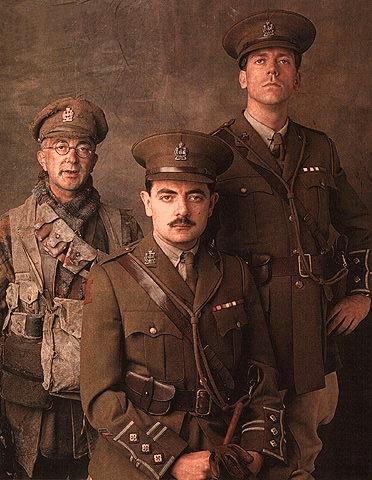
Blackadder (1983-1989) - Claiming the bronze medal is Rowan Atkinson and chums in this endlessly quotable tale of a man who's forever at the unfortunate end of a situation. Accompanied by the adorably moronic Baldrick (
Tony Robinson), the four series span the wealth of human history as Blackadder is heir to the throne, lord to Elizabeth I, butler to George V and captain in the WWI trenches.
The shows first series is often considered apart from the subsequent efforts, since it was written by
Rowan Atkinson and
Richard Curtis and featured a weak and foolish Blackadder, a far cry from the cunning, money-obsessed man, wrought with bitterness and sarcasm, who appears in Blackadder II.
The reason for this is the addition of Tory-hater
Ben Elton, who became co-writer with Curtis for the subsequent series, and the show enjoyed continual success and managed to end on a thoughtful note in the final tear-jerking episode 'Goodbyeee...' as Blackadder and the other infantry go over the top in slow motion to slowly fade into a poppy field, an end which was lauded by many families of WWI soldiers at the time.
Best Moment: Other than the fact that the show was used to teach me about 'rotten boroughs' in secondary school history, the show has a near-endless supply of classic moments, but one which encapsulates the spirit of the it is Blackadder's futile attempt to teach Baldrick to count. (
Watch it here)

2.
Coupling (2000-2004) - It would be unfair to call this 'the British version of
Friends', as it so oft has been, because there is so much more to this relationship-centred sitcom. (In fact the show was tried in America as a word-for-word re-shoot, but it was cancelled after four episodes).
Focused around six friends, the show follows the development of the relationship of the two main characters, Steve and Susan, loosely based on the real-life relationship of series creator
Steven Moffat (now Doctor Who head writer) and his wife Sue Vertue (who was a producer on the show).
The balancing act between the characters is integral to the shows success, accounting for the fall in quality in the final series when
Richard Coyle's Jeff Murdoch left the series. The other characters, aside from Steve (
Jack Davenport, of Pirates of the Carrabean fame) and Susan (
Sarah Alexander - Green Wing), are Patrick (
Ben Miles), a confident sexual preditor, Sally (
Kate Isitt), a neurotic self-depricating spinster, and Jane (
Gina Bellman), an air-headed and very sexual character who's very aware of her own attractiveness.
The show offers not only comedy, but lessons for couples and friends alike, with such wisdom as '
The Giggle Loop', '
The Nudity Buffer' and '
The Sock Gap'. The characters all offer experiences which the audience can relate to their own lives, along with a host of comedy references and discussions to ensure it isn't too grounded in reality.
Best Moment: Steve's mammoth speech on the path of man and nudity is truely a testament to the brilliance of Steven Moffat's writing and is not only hilarious, but absolutely true. (
Watch it here)

1.
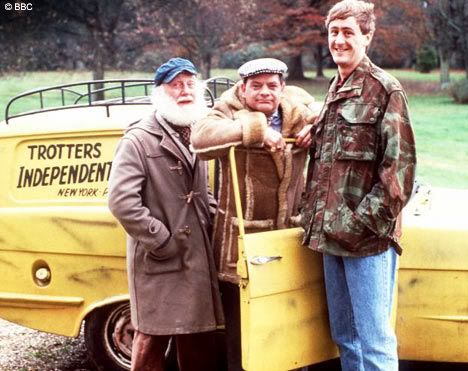
Only Fools and Horses (1981-1991) - The gold medal goes to the comedy delights of
John Sullivan's outstanding portrayal of suburban life in London, helmed by the Trotter Brothers Derrick (Del Boy), played by
David Jason, and Rodney (
Nicholas Lyndhurst).
The show spanned seven series and numerous Christmas specials, crescendoing with the 1996 special trilogy: Heroes and Villains, Modern Men and Time In Our Hands. Ignoring the lacklustre 2000's specials, the trilogy has often been said by Sullivan to be the end he intended for the storyline, with Del Boy, Rodney and Uncle Albert (
Buster Merryfield) walking off into the sunset.
Language in the show was not only very 80s but also very slang-filled, allowing younger generations to be properly schooled in what is, surely, a lost art form.
The relationship between the two brothers is central to the story, with Del as a cheeky wheeler-deeler, doing hard graft and toeing the line of the law to make ends meet, while Rodney embraces future technology and environmentalism, taking a computer science course in later series, but is marred by a past of drug use, meaning he's forced to work for Del instead of going out and making a living for himself, a fact which he constantly laments.
The supporting cast makes almost every episode classic, from Boycie's (
John Challis) caniving car deals to Trigger's (
Roger Lloyd Pack) simple-minded comments and his profound refusal to call Rodney by his name, instead calling him Dave, despite at one point having it explained to him by Rodney.
The show has created some of the most classic comedy moments of all time, and even now has relevence to modern society (particularly with the recession et al) and the rich characters and sharp writing is what makes the show deserve it's title as the Greatest British Comedy Programme of all time.
Best Moment: Naturally countless, but the Trotter brothers' trip to a fancy dress party in 1996 special 'Heroes and Villains' is a testament to the shows greatness. (
Watch it here)
Well there you have it, hopefully you enjoyed this voyage through British comedy, of course, it is only my opinion, and if you disagree then by all means say, though I do feel I should mention some higly commended:
Monty Python's Flying Circus - More than a comedy program, the films are what seperate this from the top 10, since with them they became more than a comedy programme. A truely terrific pillar of British achievement.
Dad's Army - Though considered to be amoung the comedy greats, this show missed out by it's age, since I only judged shows which I'd seen all the way through, and sadly due to the fact that Dad's Army was originally shown back in 1968, it would be unfair for me to judge it on the few episodes I've seen, though it is, undoubtedly, excellent nonetheless.





 Posts
Posts

